
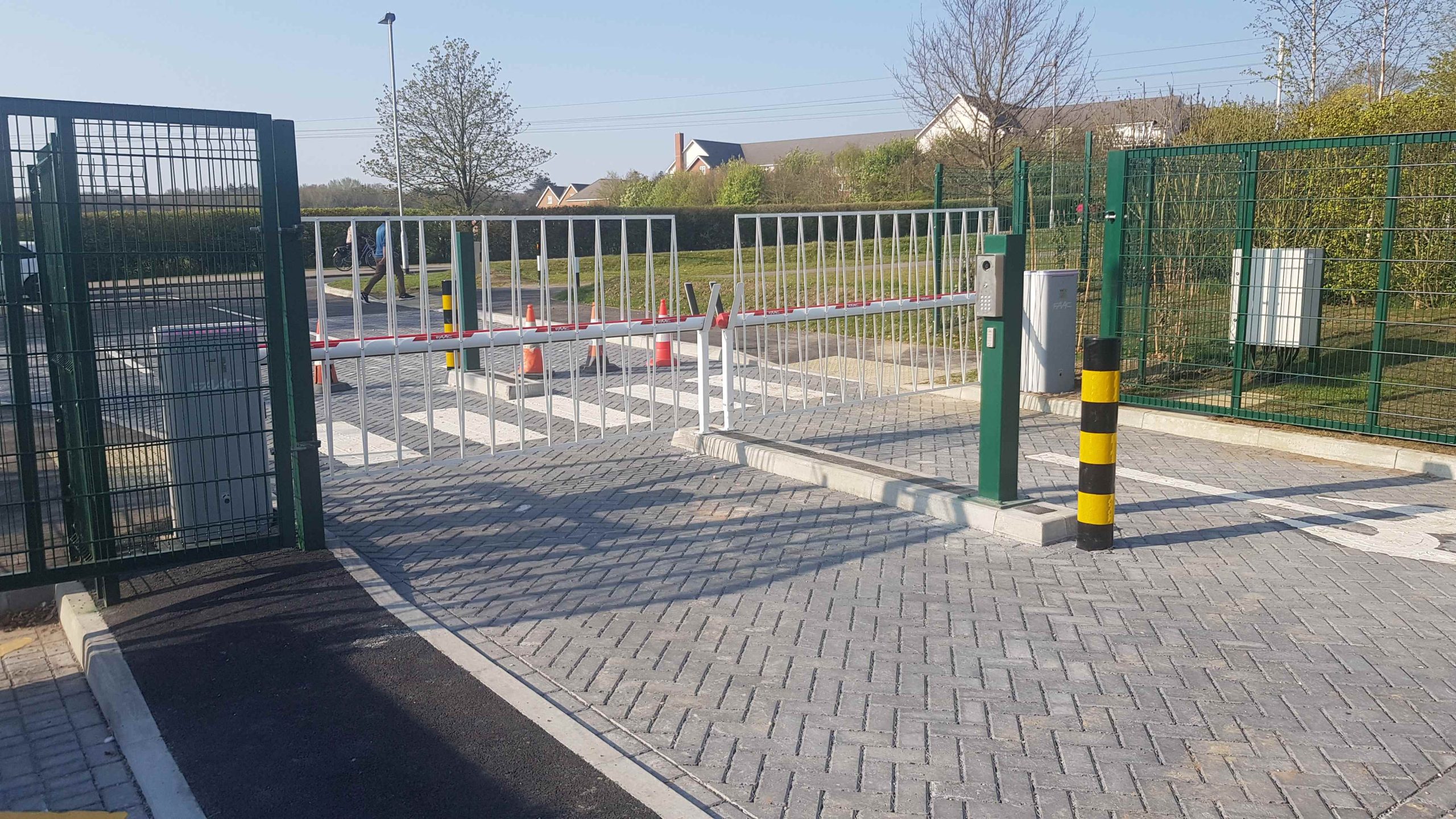

Entrance barrier Berkshire

Residential vs Commercial Security: What’s the Real Difference?

Max Smith Picture

Max Smith

8th July 2026

When it comes to protecting people and property, there is no one-size-fits-all approach. While both residential and commercial security aim to deter crime and improve safety, the systems behind them are designed for very different environments.

Residential security focuses on protecting families, homes, and personal belongings with user-friendly technology and reliable intrusion detection. Commercial security, on the other hand, is built to secure larger premises, safeguard valuable assets, manage employee access, meet compliance requirements, and provide continuous monitoring.

Understanding these differences helps ensure you invest in the right solution rather than paying for features you do not need—or overlooking capabilities that are essential.

Core Security Goals for Homes

The primary objective of residential security is to prevent unauthorised access while providing homeowners with confidence and peace of mind.

Modern home security systems are designed to be simple to use while offering effective protection around the clock. Most homeowners want to:

  • Deter burglars before they attempt to enter.
  • Monitor their property while away.
  • Protect family members and valuables.
  • Receive instant alerts if suspicious activity occurs.
  • Remotely control their security system through a smartphone.

Typical residential systems include:

  • Intruder alarms
  • Video doorbells
  • Smart locks
  • Indoor and outdoor CCTV cameras
  • Motion detectors
  • Window and door sensors

Many modern systems also integrate with smart home devices, allowing homeowners to arm or disarm alarms, view live camera feeds, or receive notifications from virtually anywhere.

Residential security is generally designed for convenience, affordability, and ease of operation without requiring specialist security staff.

Looking for reliable home security systems? Explore our home security systems to protect your property with professionally installed solutions.

Commercial Security Requirements

Businesses face a much broader range of security challenges than residential properties.

Commercial buildings often accommodate employees, contractors, visitors, suppliers, and customers, all of whom may require different levels of access. In addition, businesses must protect expensive equipment, confidential information, inventory, and sensitive operational areas.

This means commercial security solutions often require multiple layers of protection rather than relying on a single alarm system.

Commercial security commonly includes:

  • High-definition CCTV across the premises
  • Intruder alarm systems
  • Monitored alarm response
  • Access control
  • Visitor management
  • Perimeter security
  • Security lighting
  • Remote monitoring
  • Fire and life safety integration

Businesses may also need to comply with insurance requirements, industry regulations, or internal security policies.

Unlike residential systems, commercial security is usually designed to support multiple users, multiple buildings, and larger numbers of devices while remaining reliable 24 hours a day.

Whether operating a retail shop, warehouse, office, school, healthcare facility, or industrial site, businesses benefit from security systems that can grow alongside their operations.

Discover our commercial security solutions for tailored protection designed around your business.
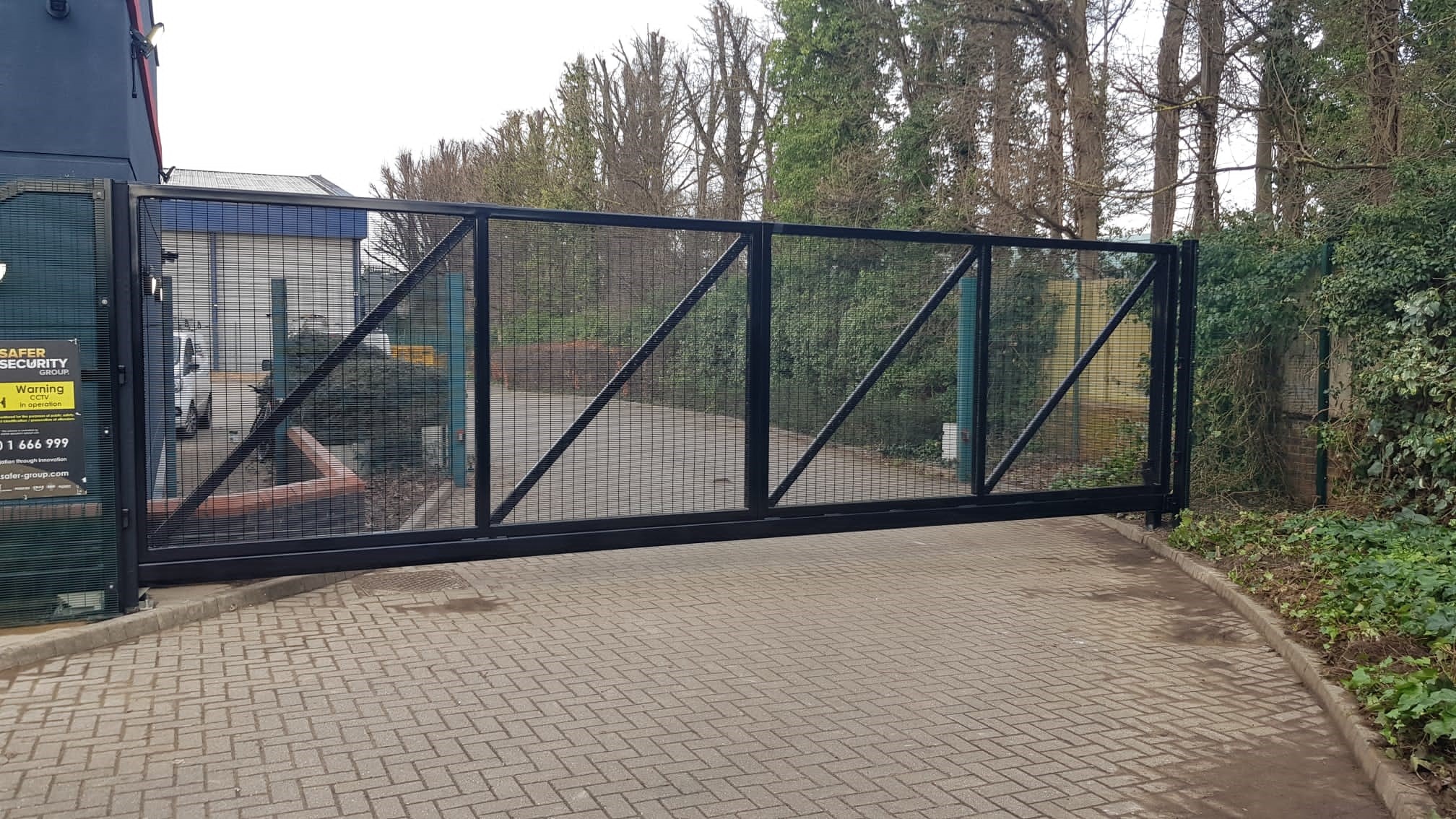
    Metal sliding gate - powder coating
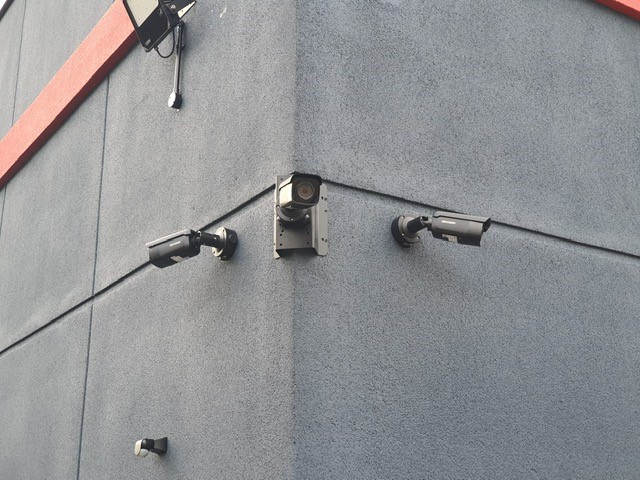
    CCTV installation Martyn's Law

    Differences in CCTV Setup

    Although both residential and commercial CCTV systems record activity, their design and capabilities differ significantly.

    Residential CCTV

    Residential CCTV typically focuses on key areas around the home, including front doors, driveways, gardens, side doors and entrance and garages. Depending on the size of the property most homes require between two and eight cameras. These systems usually include a series of features including easy smartphone viewing, motion alerts, night vision, cloud or local recording, and user-friendly mobile apps

    The objective is straightforward: provide homeowners with visibility and evidence if an incident occurs.

    Commercial CCTV

    Commercial CCTV systems often require much broader coverage as the site that needs protecting tends to be larger and more complex than a residential setting. To keep the site as secure as possible, businesses tend to monitor entrances and exit, reception areas, car parks, stockrooms, warehouses, loading bays, corridors, cash handling areas, and production facilities,.

    Commercial cameras frequently include advanced features such as:

    Larger systems may involve dozens—or even hundreds—of cameras managed through centralised recording platforms.

    This enables security teams to monitor multiple locations efficiently while maintaining detailed footage for investigations or compliance.

    Alarm System Complexity

    Alarm systems also vary considerably between residential and commercial environments.

    Residential Alarm Systems

    Home alarm systems generally consist of:

    These systems are easy to arm and disarm and often integrate with smart home platforms.

    Many homeowners also choose professional monitoring for added reassurance.

    Commercial Alarm Systems

    Commercial alarms are typically far more sophisticated.

    Businesses may require:

    For example, office staff may only have access during working hours, while management and security personnel retain broader permissions.

    Warehouses may also require different alarm settings depending on shift patterns or restricted operational areas.

    Commercial alarm systems are designed to reduce false alarms while providing fast responses to genuine security threats.

    Access Control Needs Compared

    One of the biggest distinctions between residential and commercial security lies in access control systems.

    Residential Access Control

    Homeowners typically need relatively simple access management.

    Examples include:

    The goal is to replace traditional keys with more convenient and secure alternatives.

    Commercial Access Control

    Businesses often require much more advanced access control.

    A commercial access control system allows organisations to:

    Modern systems may use:

    For organisations with multiple departments or high-security environments, access control provides significantly greater flexibility than traditional locks and keys.

    Learn more about our access control systems and how they help businesses protect people, property, and sensitive areas.

    Choosing the Right System

    Selecting the right security system depends on several factors, including:

    For homeowners, a professionally installed residential system often provides the ideal balance between protection, convenience, and affordability.

    Businesses, however, should consider a fully integrated security solution that combines CCTV, alarms, access control, and monitoring into a single, scalable platform.

    Working with an experienced security provider ensures your system is designed around your specific property rather than using a generic package.

    At SCS Secure, we assess each site individually to recommend solutions that meet your current needs while allowing room for future growth. Whether you need a straightforward home security installation or a complex commercial security infrastructure, our team delivers bespoke systems designed for long-term reliability and performance.

    Frequently Asked Questions

    Do homes need the same security as businesses?

    No. Homes and businesses face different security risks. Residential properties generally require simpler systems focused on intrusion detection and convenience, while businesses need additional layers such as access control, comprehensive monitoring, and detailed audit capabilities.

    Is commercial CCTV different from residential?

    Yes. Commercial CCTV systems typically provide wider coverage, higher camera counts, longer recording retention, and advanced features such as analytics, licence plate recognition, and AI-powered detection that are rarely required in residential settings.

    Can residential systems be upgraded later?

    Yes. Most modern residential security systems are scalable. Additional cameras, sensors, smart locks, alarms, and other connected devices can usually be added as your security requirements evolve.

    For more information on how you can protect either your home or business please contact us on info@scssecure.co.uk or call 0118 978 3381.

    Max Smith Picture

    Max Smith

    8th July 2026

    From studying for a Politics degree, Max took the less than obvious path into the environs of Security as a Locksmith back in 1985! Thirty plus years later, it’s a journey that has seen the achievement of NSI Gold accreditation for Intruder Alarms, Access Control & CCTV, plus the introduction of a sister company specialising in Gate Automation Solutions. With a wealth of both Engineering and management experience, Max has an active interest in the evolution of the Security Industry and its future direction.

    Website Built By Web Design SEO